
Badminton Court Dimensions – How Big is a Badminton Court?
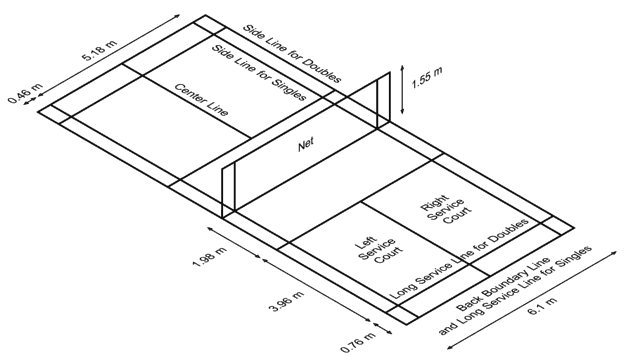
- A badminton court should be 6.1m wide by 13.4m long (20′ by 44′).
- A badminton court’s lines are typically 38mm thick (1.5”).
- The net should be 1.55m (5’1) high at the poles, but it should be lower in the middle – 1.52m (5′).
- The laws of badminton don’t specify a minimum ceiling height for a court. Ideally the ceiling should be high enough so that clears and high serves won’t be restricted.
- See below for what to do if the shuttlecock does hit the ceiling.
This diagram shows the proper dimensions of a badminton court:
Badminton Rules: Doubles – what’s in and what’s out?
- During the main part of a badminton doubles rally, every part of the court is in.
- However, the serve must fall into the ‘short and fat’ area diagonally opposite the server. The side tramlines are in, but the rear tramlines are out during the serve. (See diagram above, or Diagram A in Section 1 of the Rules).
- This means that a singles player and a doubles player have similar amount of court to cover when receiving serve (the service area in singles is 24.4m2, while in doubles it is 24.2m2).
- The short and wide doubles service area makes it harder to catch an opponent out with a flick serve, therefore allowing the service receiver to stand further forward and attack the short serves as aggressively as possible. Which makes doubles rallies fast and aggressive right from the first stroke – one reason why badminton doubles is so exciting, whether you’re watching or playing!
The Laws of Badminton
The official badminton rules (as of May 2006, when the gamed switched from 15 points to 21 point rally scoring) are found here: http://www.worldbadminton.com/rules/ This page also links to a complete historical archive of the rules – so you can check the rules which were adopted in 1873 in the Punjab if you wish! (These rules look pretty familiar – very much like the pre-2006 play to 15 points rules, but in the good old days if the shuttlecock hit the net you lost the point automatically whether it went over or not).
If you’re not sure how the 21 point rally scoring works then there’s a detailed explanation at https://www.badminton-information.com/badminton_21_points.html
For the traditionalists among you, for the old, 15 point scoring rules, best use the 1992 rules.
What happened between 1992 and 2006? There were experiments with alternatives such as 5×7, and 11 points for women’s and mixed doubles. 1992 rules are the ones most of you probably remember as the 15 point rules.
Common Questions about Badminton Rules
Is your question still unanswered? Submit it in the comments and I’ll answer it.
Ceiling
- What is the minimum height for a badminton court?
- So what happens if the shuttlecock hits the ceiling in badminton?
- Who serves first in a badminton game?
- How do you tell if your opponent is ready to receive serve?
- If I miss the shuttlecock when I try to serve can I serve again?
- If a the shuttlecock touches the top of the net when you serve but falls into the service area is this a “let” and the service replayed?
- When serving is it a fault if the frame of the racket strikes the shuttlecock and not the strings?
- When serving in doubles, can you stand within the sidelines?
- Can 2 players be in the same court while receiving a serve?
- What happens if the shuttlecock gets stuck on the net?
- Is a ‘scoop’ shot a fault in badminton?
- Is it a fault to hit the net with the racket in the follow-through of a stroke?
- Is it a fault if your racket crosses the net?
- If the shuttlecock lands so the shuttle head is outside the line but the feathers are on the line, is the shuttlecock out?
- Is it legal, as you’re about to lose the point from a disadvantaged position at the net, to merely stick your racket up to block the shuttle?
- What’s the maximum points that a winner can obtain in each set?
- If I’m watching my team play, can I give them advice during a match?
- How should you test a shuttlecock for speed?
- What’s the maximum time you’re allowed between rallies?
There is no minimum height for a court specified in badminton’s rules, but ideally it should be high enough so that clears and high serves in singles have no chance of hitting the ceiling.
There is no fixed rule for what happens if a shuttlecock hits the ceiling, it varies from club to club. Typically hitting fixtures such as lights or basketball apparatus will be a let and the point will be replayed, while hitting the ceiling itself will be a fault. In matches the home side should specify their precise rules at the start.
Service
At most clubs, it is normal practice to decide who serves first by hitting the shuttlecock up into the air. Whichever side the shuttlecock points to goes first. However, the rules say that the decision is made by a coin toss and this is how the decision is made in professional matches.
The convention is that a player is considered ready once their racket is up, they have stopped moving and they have made eye contact with the server.
Strictly speaking no. If you attempt to serve and miss the shuttlecock, the rules say this is a fault:
9.1.9 in attempting to serve, the server shall not miss the shuttle.
In this situation the server would win the point – it is not a let when the shuttlecock hits the net at any part of the game, including the serve. The only exception is if the shuttlecock gets stuck on the net, see below for the rules when this happens.
It’s not a fault to hit the frame with a serve, as long as you only hit the shuttlecock once and you don’t hook/scoop the shuttle.
In doubles the service court is extended to the sidelines, so you may serve from there as long as you don’t stand on the outer sideline:
9.1.2 the server and the receiver shall stand within diagonally opposite service courts (Diagram A) without touching the boundary lines of these service courts;
Yes, as long as the receiver’s partner doesn’t block the server’s view of the receiver:
9.5 In doubles, during the delivery of service, the partners may take up any positions within their respective courts, which do not unsight the opposing server or receiver.
Faults
a) On the serve it’s a fault if the shuttlecock:
13.2.1 is caught on the net and remains suspended on its top;
13.2.2 after passing over the net, is caught in the net;
b) After the serve, it’s a fault if the shuttlecock:
13.3.3 fails to pass over the net; and it’s a let if the shuttlecock is:
14.2.3.1 caught on the net and remains suspended on its top, or
14.2.3.2 after passing over the net is caught in the net;
It’s a fault if during play, the shuttle:
13.3.7 is caught and held on the racket and then slung during the execution of a stroke;
Yes, it’s always a fault if you hit the net with your racket during play.
It’s a fault if a player:
13.4.2 invades an opponent’s court over the net with racket or person except that the striker may follow the shuttle over the net with the racket in the course of a stroke after the initial point of contact with the shuttle is on the striker’s side of the net;
Yes.
Yes, it’s legal to try and block the shuttle like that – as long as your racket isn’t on your opponent’s side of the net when the shuttle hits it, then you can have your eyes shut, be hiding and still legally return the shuttle – and even win the point!
Having said that, rule 13.4.4 says it’s a fault if a player ‘obstructs an opponent, i.e. prevents an opponent from making a legal stroke where the shuttle is followed over the net;’.
In other words, it’s actually a fault to hold your racket up so close to the net that it gets in the way of your opponent’s swing (don’t forget – it’s legal for your opponent’s stroke to finish on your side of the net as long as they hit the shuttle on their side and don’t hit the net in the process).
In practice this rule rarely comes into play – it just means don’t take the mickey and hold the racket up so close to the net that it’s right under your opponent’s nose.
General
A winner normally plays to 21 points, but to win you have to be at least 2 points ahead, up to a maximum of 30 points; which is the maximum a winner can obtain.
16.5.1 Only when the shuttle is not in play (Law 15), shall a player be permitted to receive advice during a match.
3.1 To test a shuttle, a player shall use a full underhand stroke which makes contact with the shuttle over the back boundary line. The shuttle shall be hit at an upward angle and in a direction parallel to the side lines. Also see this video about testing the speed of the shuttle.
There is no time limit but a badminton game is meant to be played continuously so it as the umpire’s discretion to hasten the players when necessary. The rules talk about delays and allowed intervals:
16.4 Delay in play
16.4.1 Under no circumstances shall play be delayed to enable a player to recover strength or wind or to receive advice.
16.4.2 The umpire shall be the sole judge of any delay in play.
16.1 Play shall be continuous from the first service until the match is concluded, except as allowed in Laws 16.2 and 16.3.
16.2 Intervals
16.2.1 not exceeding 60 seconds during each game when the leading score reaches 11 points; and
16.2.2 not exceeding 120 seconds between the first and second game, and between the second and third game shall be allowed in all matches. (For a televised match, the Referee may decide before the match that intervals as in Law 16.2 are mandatory and of fixed duration).
That’s the end of the Frequently Asked Questions. Is your question still unanswered? Submit it in the comments and I’ll answer it.

How long can a player get treated for injury on field, before s/he forced to forfeit the match?
what if the racket is outside the service court front line while serving, is it a fault or not?
During a double’s rally, the shuttle touches my partner’s hair (body parts) and land in my opponent court. Do we get a point or my opponent?
In doubles badminton can the receiver’s partner call for the receiver if the service is wrong????
Please send cost of Badminton court village level questions
What happens when a shuttle comes onto court from an adjacent match?
Generally the match is restarted again
The point is replayed, not the match.
During game I missed a shot but I had enough time to get myself on track and hit the shuttlecock while it was in air, will this be considered fault?
no as long as you don’t touch it the first time
Thank you very much for sharing this informative article it will for sure help me in enhancing my Badminton game, I think to Enhance your game we should have a good knowledge of Rules and Regulations of the game.
The shuttlecock was still in my opponents court and was yet to to touch the ground,but my racket touched the shuttlecock under the net. Who gets the point?
Whether I will get point if I serve and the shuttle touch the service line of the opponent.
What to do if the shuttle base (cork) breaks between the rally. Should it be reserved or the points will be given according to the landing of shuttle ?
Please let me know soon as possible
What to do if the shuttle base (cork) breaks between the rally. Should it be reserved or the points will be given according to the landing of shuttle ?
What if the base of plastic Shuttle breaks between the rally, will it be reserved or the points will be given as per the landing of shuttle..??
Is jump smash allowed from the front line?
What if in a doubles game , a server serves the shuttle and it touches the net and falls in the reciever’s short service line ?
Tell me whether the service is correct or not and who will gain point ?
Reply fast . Its urgent please.
If, while playing a shot the racket touches the ground. Will it be considered as a fault?
sir on doubles service ball felt down on back side corner box touching inside line it’s correct service or wrong service
What if during play my racquet touches the floor of the court while trying to defend a smash. Is it illegal?
Need to know the rules: Are the following circumstances correct or wrong?
If racket hit the floor while right before taking a shot to the shuttle. For make clear, there is a gap of time (possibly fraction of a second) between “Racket hit the floor” and “Racket touch the shuttle”.
What are the instances when a service court error is made by a player and what is back gallery ???
thanks for this helpful article.
i have a question. is there any specific rule regarding receiving service? i mean, can a player, at receiving end of a service, step into the first court to attack the shuttle, after the shuttle has been served?
I see you don’t monetize your blog, don’t waste your traffic, you can earn extra cash every month
because you’ve got high quality content. If you want to know how
to make extra money, search for: Boorfe’s tips best adsense alternative
Which line do you not use after serving?
If the player or ball/shuttle is out of court, what would the official award?
If players goes out and play. No problem for he/she can play outside the court also
We have got into the finals, but my partner is not feeling well and he can’t make it. Is it possible can we let substitute to play for the next game?
Hello and hope you can help this is a REAL incident.
Team A wanted to throw away team event match (best of 3) against team B thus they deliberately lost the first mens doubles.
When the second pair match is due, Team B responded that the team members left the stadium thus handing the match to team A. Team A players were on court BUT then replied that they would also like to withdraw from the match citing injury.
Question – who is the rightful winner?
Can a player halt play. If yes under what circumstances. If no, then who can halt play and under what circumstances.
Hi Michael,
I’m Julie from MightyGoods.
Saw your page where you’ll know how big a badminton court is. (https://www.badmintondoubles.com/badminton-rules/)
After taking a closer look at your site, I think you will like the badminton diagram we have made.
Please check it out here: https://mightygoods.com/sport-courts/
Do you think you can use the diagram on your site? I’d love to hear what you think about it.
Thanks,
Julie
During the play if the opposite player hits the shuttle and the shuttle head lands half outside and half inside the side line or baseline is it legal or out
Hi,
In the Doubles play, is it legal to serve from sideline to diagonally opposite court’s top right corner (meaning the shuttle is crossing the same court and center line).
Kindly clarify.
Is it a legal serve if I do it from double side line to diagonally opposite court’s top right corner? It means shuttle is crossing the middle line. Please clarify
What if I serve and after serving the reciever cross the service line and come near the net and hit smashly the shuttlecock
Can reciever hit the shuttle cock during serve by crossing the service line
What happens if I try return the shuttlecock and miss it completely but the shuttle goes out of court? Does that mean I still win the point ?
if i score 9-0 … it means i won !? or i hve to play till i reach 21 points
The convention is that a opponent is considered ready to take the serve once their racket is up, they have stopped moving and they have made eye contact with the server.
my question here is whether the opponent can make any movement/jerk just before the serve is made.
Thanks,
Kiran D S
Hi, somebody told me that after the recent Olympics , service rules have been modified.
Can you please clarify if while serving, the shuttle cock touches the net (gets a bit deflected) but falls inside the opponent’s court (at proper area), will this be a ‘reserve’ or point for the server ?
And in a case, the receiver receives/touches such deflected cock,will it still be a ‘reserve’ ?
What I know such net touched serve was considered to be fine earlier. And point was given depending upon the loction the cock falls down.
Question: Is it illegal to raise your racket and call the shuttlecock out before it lands on a serve?
In order to be ahead of time of other folks, you should use
the particular hack software or be a cheater
codes powerplant Below are some fundamental features of bot.
I have a question.Let’s say I’m playing a single match the opposition hit the shuttle it hits the out line but goes over it does that count as a point?
What is the minimum holding time of cock during serve ?
Whatbis the minimum holding time of cock during serve ?
While serving the cock can opponent bend their legs to receive the cock
Is pushing of cock is a fault or right?
O.K.
Hi what about a player trying to hit the shuttle only after the first attempt that’s second attempt.. I mean if he miss to hit in the first can he go for second attempt before the shuttle reach the ground?
I liked answers. ..great….one question plz
What if shuttle touches its some part on line and some part outside the line….who wins points. .is it LET?
During service for doubles, if the server served the shuttlecock but it has NOT cross the net, can the receiver react immediately to leap forward to the net area before the shuttlecock has cross the net?
Refer double game.
Is it foul or legal if at the time of service shuttle drops onto the opponent’s side but prior to service line?
If I struck racket and completely
Miss the shuttle without touch my body and immediately I struck second time and shuttle cross rally..then it is legit or if I miss first time to hit then it’s gone ?
I sometimes serve a shot which does not go diagonally and direct to the receiver…if the receiver hits the shuttlecock (even though I never served it correctly) does play still continue and how does the pointing system work in this instance?
who will correct the wrong service court? Umpire or player?
hi
this is madhu sudan my question is,
In doubles/ in single player when making a serves ,the cock should cross the service line or we can make a service within a service line,or where ever we can make service in courrt
hi
this is madhu sudan my question is,
In doubles/ in single player when making a serves ,the cock should cross the service line or we can make a service within a service line,or where ever we can make service
if the racket touches the ground while we play, will it be a foul?
in doubles if the shuttel touch to frame at service time & at the game is it falls or not
Where should a cork fall when we do a long or short serve in singles or doubles ?
Where should the cork fall when I do a long or short in a singles or doubles?
What happens if when you try and return the shuttle your racket is in contact with the floor and when you return however the shuttle doesn’t hit the ground?
surely play continues as the shuttle hasn’t hit the ground?
During delivery of service in a doubles game, can the partner be standing with a foot each in the two diagonals so long as he/she is not unsighting the server and receiver?
what is the rule if the shuttle hits the net but has not yet hit the floor and a player then hits the net
in Doubles can server use wrist jerk to send shuttle near backline ( it remain below the hip while delivering service
Yes, but racket must also be below horizontal angle at point of impact.
What is the regulation or rule for if a player gets injured mid rally?
dont know soz
I don’t think there’s any special treatment for players – if a player loses the point because they’re injured then they lose the point. And if they can’t play on, they forfeit the game.
If the whole shuttle falls on the line neither in nor out will it be out
It’s in. If the shuttle touches the line it called in. Point goes to opponent.
If it is serving and lies in short line, is that in or out
No. It will be in.
If it is during service is it in?
wow because on my badminton test it said it “Out” was the correctt answer :L
Whose point is it if two rackets clash
Play continue.
If only one Racket hits the Shuttle then its ok, the rally will continue.
Prasad
I did not quite understand 13.3.9 of the rules…
Is it possible you explain it to me.
rule 13.3.9
It’s a fault if in play the shuttle “is hit by a player and the player’s partner successively”
Only one of a pair may return the shuttle to their opponents – if you hit it and your partner “helps it” over the net it’s a fault.
It basically means if you hit the shuttle but it doesn’t cross the net and land in the play area
What is meant by LET
LET means the point will be played again.
Prasad
Hello i have a question listed below
In double game, if a serve hits to body of a non receiver standing on his/her court so is that fault of server or receiver?
Fault of receiver. Point goes to server
Hey, my questions is, what if in double badminton i serve the shuttle the it land to the wrong half court then the opponent catch it, will it be my point or them?
If it lands out, it’s the receiver’s point. If they catch it in their hand or it touches their body or clothes or racket or their partners body or clothes or racket before it lands in or out, it’s the server’s point
Can a player cross over to the opponents court to point out where they believe the shuttle landed? IE the opponent called it out, but you believe it was in. Who makes the calls?
My leagues play with the following etiquette:
You make the line call (decision if it was in or out) on your side of the net.
If your opponent(s) disagree with your call, they can ask for a let.
You then decide if you want to give a let and replay the point.
I can’t see anything in the official rules about this – they only deal with umpires and referrers and line judges.
In Doubles, is it a fault to hit my partner’s racket unintentionally? But the shuttle hits only one racket but still able to receive the shuttle.
I think that so long as only one racket has hit the shuttle and made a legal shot, both partners rackets can accidentally hit each other during the action
What if I hit my partner’s racket during a rally unintentionally, but the shuttle hits only one racket, either mine or his, do we lose a point?
No that’s fine
If a player deliberately smashes the shuttlecock at an opposing player is it a) a foul b) poor etiquette c) neither.
Hugh
At competitive level this is perfectly fine
At club level it would still be considered ok I think in general.
If you were playing a pair that could not defend your smashes and you repeatedly smashed at their faces or in a way to physically hurt them – I would consider this poor etiquette.
When i serve the shuttle hit the body of the man in the wrong court (wrong court means not the one we need to serve) with out any obstection by that player. Then is the serve is right or not??
That’s a point to the server. Whether your service was going to land in or out.
in singles are the side lobbies in or out ???
Side lobbies/tramlines are out in singles
In a doubles game, once C has served, what must she and her partner D do once they win the point and go to serve again?
Mandatory: swap sides
Optional: high five
hi am new to badminton , we were playing doubles and we had a situation where me and my partner hit the shuttle back at the same time and my racket and my partners racket touched each other, at the same time the shuttle touched one of our rackets and went back into opponents court. now is this fault? to play such shot ? or is it legal to continue to the game?
This is a legal shot so long as the racket that hit the shuttlecock hit it in a smooth continuous motion
When serving what if the shuttle hit on the centre line, who share the point
That is ‘in’ and the server gets the point
I am very inexperienced but if the birdie is in the air, but out of bounds, could the defending team/player hit the birdy and catch it to receive apoint
If the shuttle is out of the bounds of the court on your side, you should let it land out to win the point. Even if it is way out, you shouldn’t hit, touch, catch it, as that would be a point to the other side.
You cannot touch birdie until it falls down and touches the floor
Hi there,
If, in the course of a rally, a player puts their foot on the opponents side of the court but does not touch the net, is this a fault?
Thanks
Greg.
This is a fault.
Prasad
it many not be a fault, as long as he didnt touched the net and distract the opponent.
Only a fault if;
13.4.3 invades an opponent’s court under the net with racket or person such that an opponent is obstructed or distracted
So, only if placing of the foot obstructed or distracted the opponent would it be a fault. In my book, just a foot placement wouldn’t do either. Sliding under the net on the other hand would probably do both.
While the ball is in play, I returned back a shuttle to my opponent , lost balance and moved outside my side of the court. The opponent smashed it back on to me (standing outside the line on my side of the court). Is the ball “in” and does my opponent win a point?
S of course..you opponent wins a point.. because the shuttle cock touches u before lands on the ground..
If the shuttle hits any part of you or your racket before landing, it is a point to the other side, even if you are stood outside the court.
13.3.5 says it’s a fault if it touches the person or dress of a player.
13.3.6 says it’s a fault if it touches any other object or person outside the court.
I’d say that if you’re outside the court, 13.3.6 applies and it’s your point. If 13.3.5 applies it’d be your fault, but you might get into arguments about it if you weren’t obviously outside the court.
During play, I returned back a shuttle to my opponent , lost balance and moved outside my side of the court. The opponent smashed it back on to me (standing outside the line on my side of the court). Is the ball “in” and does my opponent win a point?
during a doubles play, can i go outside of the boundary lines to hit the shuttlecock that i can’t tell is good or bad? (2) question- can i step inside the serve area to get the serve? can my arm reach over the serve line into the serve area to return the serve?
Please can you help me with this question?
In badminton if your opponent fails the serve, do you get a point?
Single tennis betminton serve third court are right or rong
Am I allowed to use both the Hands while playing international game?
What happen if any one say outside from audience in favour of any team before the landing of suttle?
If a player crosses the short service line while the game is in play is this a fault?
Or
If the shuttle cock doesn’t crosses the short service line while playing is that a fault???
My Question is
If i am serving while playing a double game, and the partner of the receiver makes a call ‘SHORT’ while the receiver picks it neatly.
What does the rules says. Is it a point for the Server since me is been distracted.
Rakesh Arora
Hari Nagar Sport Complex, New Delhi.
Your doubles opponents are entitled to communicate with each other – loudly if they wish. You have to ignore them and play your own game. You cannot claim they distracted you from you shot to claim a point or let.
Is it a foul if my foot crosses the net from below the net due to the momentum and my body or racket doesn’t touch the net?
It will be fault.
Prasad
Is tossing the shuttle cock compulsory/necessary while serving, especially in long serve?
There are strict rules about the service action – check the BWF website
What is the Max time we can hold the shuttle before service
If shuttle hit the center line on receivedrs end which devides widthwise receivers court is it fault & what is it called
Lines are ‘in’ in badminton. So if a service lands on any line that surrounds the receivers box, the service is ‘in’ and the server gets the point
Hi,
Thanks for listing out the do’s and don’ts. I would like to ask a quick question.
In doubles is it a fault to receive a serve intended for me by moving over to my partner’s court?
I ask this because yesterday while playing doubles, the receiver stepped into the his partner’s court to receive the serve. Following which, there was a huge row between the two teams whether that was a fault or not.
Yes that’s a fault
How is that a fault? The receiver is receiving the serve, and his/her position doesn’t matter as long as he/she had both feet touching the ground till the serve is made. AFAIK, the receiver can receive the serve anywhere as they wish.
Sorry I misread the question. Ashish is correct – it’s not a fault. Once the service has been started, the receiver can move anywhere. If the shuttle heads towards the receivers partner, the receiver could leave his box and hit it and the point continues as normal.
after server if i hit the shuttle and it touches the top of net and goes to opponent side is it foul
no.
if my clothes touches the net while hitting the shuttle and racket does not enters to opponent side
is it foul
Yes
Hi, Thanks for this valuable help.
My question: Can the partner of a doubles team stand anywhere, including the server’s court when the server is serving?
Yes, so long as they are not in a position to obstruct the receivers view of the service
I’m not exactly familiar with the terms and rules of badminton, but in doubles, are you allowed to cross the middle line in order to help your teamate, located at the backline, and perform a counter?
Samuel
Yes. You don’t have to stick to one side of the middle line.
Only the server and receiver have to stand within the bounds of their boxes (diagonally opposite) as the server starts their serve. The other 2 players can stand anywhere they like so long as they are not obstructing the server or receiver.
Once the service has started, any player can move to any position in or outside of their half of the court. No part of their body or racket can touch, pass over or under the net (except having made a shot – see other responses below)
Is out of play if a shuttle hits something outside the opponent’s court lines that is not the floor or wall?
Before the match the players should agree upon what will be considered a fault and what would be a let if the shuttle hits it – regarding fixed obstructions around the court.
At some venues I play at, the ceiling is considered a fault, but overhanging beams are considered a let. If the shuttle hits those beams then the point will be replayed. At the top level there would be nothing that the shuttle could possibly hit within the confines of the court.
Normally a fault would be played if the shuttle is heading away from the court and hits an obstruction such as a passer-by say. I suppose it’s possible, however, that a shuttle could be hit far outside the court bounds, and be heading to land IN the opponents court, and hits a passer-by! In which case perhaps a let should be played? If the passer-by is actually one of your opponents, then it’s definitely a fault as that is catered for in the rules.
Is it a foul if a player steps on the net line at any point in the game, when the shuttle is on either side ?
You mustn’t touch the net or pass over to the other side of the net whilst the shuttle is in play (in the air). the point at which your racket touches the shuttle must be on your own side of the net but if your rackethead passes over the net (without touching it) during the shot, that’s allowed.
I have a question. ..
what if in a doubles game, both players attempt the same shuttle and their raquets stricks each other. Then in that case is it considered as a foul or not.
That’s not a fault unless the shuttle touched both rackets or was hit illegally somehow
Pingback: Badminton Cork | Birg
We are having a problem with one thing
in doubles if player 1 racquet hits the players 2 racquet trying to return the shuttle to opponent ,
Is it considered to be a foul or no foul
That’s not a fault unless the shuttle touched both rackets or was hit illegally somehow
Pingback: Badminton Serving Rules | Birg
Pingback: What Is Badminton | Birg
Pingback: Badminton Regulations | Birg
Pingback: Peraturan Badminton | Birg
Pingback: Badminton Rules Singles | Birg
what if the opponent serves intentionally to wrong court and hits the wrong court player.
I think this would be a point to the server. It would be up to the receiver’s partner to avoid the shuttle and let it land out to get the point for themselves.
can we serve from right corner of right service court or left corner of left service court??
……………………………………………………………………………………………..
……………………………………………………………………………….
| | X |
| | |
| | |
………………………………………………………………………………
| | |
| | |
| | |
……………………………………..X……………………………………..
……………………………………………………………………………………………….
Yes you can serve from anywhere inside the relevant service box.
in doubles when the wrong person do the serve and the opponent touches the shuttlecock, so is the serve is right or wrong ?
BWF rule 12 say that if a service error occurs such as this where players have served out of sequence, the error should be corrected and ‘the existing score shall remain’. This isn’t 100% clear. It seems to suggest that the correct person should continue the game with everyone standing in the correct places, but that the score should include the points earned during the incorrectly played point(s)
This is unclear to me as well. Can anyone tell me the official interpretation of the rule 12.2? Especially, what is the meaning of ‘the existing score shall remain’. Can it be interpreted so that the last (erroneous) service doesn’t count?
Further question: Can I call ‘Let’ during play if I notice a service court error?
If anybody can suggest about the badminton rules what will happen if service struck the opponent body in same court area
That is an immediate fault regardless of which opponent was struck or where they were standing. The server wins the point.
Are there any rules regarding the racket touching the floor?
If yes, then do they have different rules for deliberately touching the floor with the racket?
Clubs here consider racket touching the ground as foul. No matter how the rally is progressing, when the racket touches the floor, opponent is awarded a point.
I had another doubt regarding racket clash in doubles, but I got the answer by going through the comments.
There are no rules against this as far as I can see although if you hit your racket against the floor and it distracts your opponent and they make a mistake they might argue a let is in order.
If by chance i cross the netline while playing a stroke but my body doesnt make contact with the net
Is it a foul
Your racket and arm can only cross the netline after playing a shot, so long as the shuttle is on your side of the net when you hit it and nothing besides the shuttle touches the net. Besides this I think it’s a foul if any part of you or your racket passes the net line whilst the shuttle is still in play (in the air)
Is it a foul if a player steps on the net line at any point in the game, when the shuttle is on either side ?
Are players allowed to deliberately slow the game down by taking a long time between points to ‘discuss tactics’ before getting ready to serve or receive?…
Not according to the official rules and top level players are penalised for doing this. At club / league level it’s normally down to the individual players about how fast the game is played.
In doubles, if a serve is so bad/wide that it hits the non-receiving opponent in the non-receiving half of the court, does the server still win the point?…
Yes I believe so.
while doing the service , if the cock falls before the service line of opponent court , then who gains the point ?
Opponent will get the point
if the shuttle cock touches the net and fals in opponent court , then who gains point
you do.
I hav one doubt please help me…. during a match if a cock has struck on the bat whats the judjement
During play the shuttle hit the top of the nets post and landed in on our opponents side. Should we have been given the point?
Yes
In doubles serve is corner box right
Where can the shuttle land in normal play after
the serve in singles and in doubles
Hi in singles games does the back long service line remain open after the service
Yes
Hi my question is if the service receiver attempt to hit the ball by crossing the service line is right or wrong….
It’s fine to cross the service line once the serve has been hit – as long as you don’t move your feet before the server’s racket makes contact with the shuttle.
Hi…. is it a foul to play/smash with both hands….??? I mean… most of the times …when the shuttle comes to my right side I use my right hand and left hand for left side’s shuttle…. I am using both hands by swapping the Raquette. ….is it okay or faul…..pse solve my problem…..
I don’t think there’s any rule against it.
But it is very bad technique! Tennis players play double handed backhand for extra power, but in badminton, with the right technique you can generate all the power you need with one hand. I would get some coaching or advice regarding your technique.
Most importantly – make sure your backhand grip is right and practice changing from forehand to backhand grip. A good guide is here:
http://www.badmintonbible.com/articles/grips-guide/grips/thumb-grip.php
I don’t think manoj is playing double-handed, but swapping the racket from one hand to the other. A bit like Ronnie O’Sullivan with his cue.
No, it is not fault, it is allowed. You can use your left or right hand separately or together. In tennis it is also allowed, my Indonesian tennis player named Lita Wibowo uses both their hands, left or right separtely. She never uses her both hands together. I saw this match held by ITF 25 years ago. I does to in badminton
Hey Folks,
I am playing since a few years now, And I fairly know badminton and its rules pretty well.
But, while playing doubles today, a friend of mine pointe out a foul, which I felt was absurd.
Please help me clarify the doubt.
While serving in doubles, before she(my opponent), made contact with the shuttle, I made a move for a kill shot, apparently she noticed it and placed the shuttle at the rear end, which was out. Then she claimed it was a foul, as I started early. Is it true, that If i start early for a kill or a any movement, before the opponent touches her shuttle, its considered as a fault.
Thanks in advance.
I’m afraid, she’s right – when receiving serve you can’t move your feet until the server’s racket has made contact with the shuttle.
She is right, You made a fault. You can not move your feet until she hit the shuttlecock. It is called fault by receiver or receiver fault.
Is Back court serve in singles and doubles legal ?
hey..In a game do we have to score 21 points to complete the game, even if the opponent score is zero??
Yes
suppose the opponent is serving to me, can I cross the service line and return the service??
Yes. But…
You have to be inside your service box before your opponent starts their service motion. As soon as he /she moves the racket forward towards the shuttle you can move. You are not allowed to move until that point.
Actually that’s not quite right.
Rule 9.1.3 says that the receiver (and server) cannot move their feet from the start of the service (first forward movement of the server’s racket, see 9.2) until the delivery of the service – when the shuttle is hit by the server’s racket (see 9.3).
So you are not allowed to move until the server has hit the shuttle. After that you can cross the service line and return the serve.
Oh yes. Michael, you’re right of course. I’ve been too lenient with my receivers!
Is the on the line service wrong?
Jeet – I think you’ve missed a word.
If you’re asking if you can put your feet on the service line when you serve – the answer is NO – you mustn’t touch the lines during service. The stops both players getting an advantage by getting too close to the net.
Rule 9.1.2 – the server and the receiver shall stand within diagonally opposite service courts … without touching the boundary lines of these server courts.
what should be the racket position while we serve???
From the Badminton World Federation’s Laws of Badminton (http://www.bwfbadminton.org/file.aspx?id=558306&dl=1)
9.1.5 – the whole shuttle shall be below the server’s waist at the instant of being hit by the server’s racket. The waist shall be considered to be an imaginary line round the body, level with the lowest part of the server’s bottom rib;
9.1.6 – the shaft and the racket head of the server’s racket at the instant of hitting the shuttle shall be pointing in a downward direction.
So the racket must be angled downwards with the head on the lower end and at the point when the shuttle is struck by the racket head, the whole shuttle has to be below your waist. I don’t think there are any more rules around the position of the racket.
whats the service rule in singles?? can we serve till the long border line??
Melvin
Yes.
The back of the court has two lines – the inner line is ONLY used as the back line for the doubles service box. The outer line is used for ALL other shots.
Singles Service box is LONG and THIN (rest of the game the same)
Doubles Service box is SHORT and WIDE (rest of the game is LONG and WIDE)
Hi, just want to clarify a point about striking the net. If I hit the net after playing my shot BUT I only make contact with the net after the shuttle has touch the floor on the opponents side is this a fault or ok as the point has already ended.
Cheers
Max
Yes if the point is over then it’s legal. This normally only happens with a fast downward smash when the shuttle is on the floor and the player is unbalanced or momentum carries them into the net so unless it’s clear to everyone you might find your opponent requests a ‘let’.
Similarly…
You think your opponent’s net shot is coming over the net
You attempt to return it
Your racket touches the net on your side
The shuttle doesn’t come over and starts falling to the floor on your opponent’s side
This is a fault because the shuttle is still in play until it hits the floor
Matt
Great article! However, I do have a question:
Are my partner and I allowed to pause between rallies to take a sip of water or to catch our breath? We take no more than five seconds. We’ve always done this and no one has ever called us out on it. But recently I’ve been wondering if this is a violation of the rule 16.4.1. Thank you for the answer!
m ngu
I think the answer to this depends on the level at which you’re playing. At the top level players are definitely not allowed to behave as you describe and can only take a break at the discretion of the umpire. I don’t know anyone at league or club level that forbids taking a break – but I have experienced upset opponents when I’ve taken a quick sip of water during a game. And if someone was to take a sip of water after every long rally I think it would annoy and disrupt an opponent especially in a competitive game.
Is it a service fault ? , While serving from right side court in single or doubles, if shuttle crosses or goes through the adjacent court of receiver.
Anand
‘No’ is the short answer – assuming I understand the question correctly.
Long answer…
When you serve in badminton you must serve from your RIGHT side to your opponent’s LEFT side (or from your LEFT side to your opponents RIGHT side – rules are the same either way).
So when serving from the RIGHT (for example)…
If the shuttle passes from your RIGHT side – over your opponents RIGHT side – then lands in your opponents LEFT side, this is NOT a fault.
If the shuttle passes from your RIGHT side – over your RIGHT side – then lands in your opponents LEFT side, this is also NOT a fault.
It doesn’t matter where the shuttle travels in the air – so long as it’s struck by you standing INSIDE the lines of your RIGHT service box and lands INSIDE OR ON the lines of your opponent’s LEFT service box.
Please clarify the FAULT when racket crosses over the net. The rules are a bit unclear as stated: “13.4.2 invades an opponent’s court over the net with racket or person except that the striker may follow the shuttle over the net with the racket in the course of a stroke after the initial point of contact with the shuttle is on the striker’s side of the net;”
Quite simply: If I missed hitting (air shot) the shuttle AND my racket still crossed over the net (intentional or unintentional), is it a FAULT?
Hi Garry
I understand the rule as follows – perhaps others might like to correct me if i’m wrong…
If your racket or your body passes over the net at any point it’s a fault unless…
If you hit the shuttle legally on your side of the net and after the contact of the shuttle with your racket, your racket and/or your arm pass over the net.
If your racket or body touch the net it’s always fault.
And you’re not allowed to pass over the net to hit the shuttle on your opponents side – the shuttle must be on your side of the net before you make contact with it
hope that helps
matt
Hi,
If I served and receiver hit the shuttle over the net which could be land in opponents(receivers) side, but I hit back on their side inside boundaries of the court, it will be a fault or in?
Tahir
At the moment your racket touches the shuttle, the shuttle must be on your side of the net. Your racket can pass over the net after this point. So you have described a fault.
Hey thanks Matt for your valuable reply.
Can the non-receiver have one foot within the area between the Short Service Line & Net, if he is not causing any hinderance to the the receiver / server? Under which rules can this be applicable
Manoj
The server and receivers partners can stand anywhere so long as they don’t block the view of server or receiver
According to rule 9.5 of the BWF rules here: http://www.bwfbadminton.org/file.aspx?id=539239&dl=1
hello
my Quesyion is that in double game,
if opponent serve to me digonally and my partner call for in or out.then is it faul or not
Your partner is allowed to call in or out or communicate with you in any way. They can advise you at any point to play or leave a shot or to do anything but one pair cannot say things to deliberately distract the other pair
Right, I have a question. In doubles if I’m serving and the reciever is ready but his/her partner is not ready, am I alowed so serve or not. Is it up to the reciever to make sure that theor partner is ready?
Yes, it’s up to the receiver to make sure their partner is ready.
The server is allowed to serve as soon as the receiver is ready.
Thanks for the rapid response! Just had to have this cleared up, thought this was the case, but in a recent match I got told off for doing this. I stood my ground to the oppnent. I am 16 years old playing in senior games, and where ever I go, I feel as if I as a “child” I am some sort of easy target.
Hi, I have a question: If the shuttlecock touches a player/ player’s shirt but the player happens to be outside the court at that particular moment, which side gets the point? (Say the player was running to hit the shuttlecock but at the last moment pulls away to avoid hitting it because he gauges that it will be out… at this point the player is already outside the court, however the shuttlecock touches him or his shirt (while he’s outside the court) while falling.) Thanks for your help!
The shuttle is only out when it touches the ground or a wall. So if it hits a player first it’s not out.
It’s an immediate fault if the shuttle touches the player or their clothing regardless of whether that stops the shuttle landing in or out. The side touching the shuttle would lose the point.
If a server is in a ready position to serve but has not made a forward swing of the racket, and the shuttlecock falls from his other hand, can he pick up the shuttlecock to begin serving again?
Generally at my club we say as long as he doesn’t make contact with the shuttle then it’s ok to retake the serve.
But I’m not sure what the official ruling is.
I think that it’s the forward swing that starts the serve so dropping it before that point is fine, you can try again, but dropping it after the forward swing would be seen as a failed service attempt and a fault.
I have enjoyed reading these questions and answers.
I have one question which was not addressed:
Is it a fault to talk to my partner when serving or during play?
Kenneth
I’m not 100% sure about this one
The BWF rules say (rule 13.4.5) that it’s a fault if, in play, a player..
‘deliberately distracts an opponent by any action such as shouting or making gestures;’
So at what sound level does talking become shouting?
And who decides whether communication with your partner is distracting to your opponent? Or deliberately distracting?
I would say that making any noises as you served would be deliberately distracting to the receiver.
As would saying ‘in’ or ‘out’ or similar to influence an opponent as they went for a shot that may or may not land in or out. In fact any verbal comment directed at your opponents during play might be considered distracting by them (especially if they lose the point). It is probably normally clear by the comment and the timing of it whether a comment is aimed at your partner or your opponents.
I would say that hearing your opponent make their shot – using the sound that’s made when the shuttle hits the racket – is a another tool in working out where the shuttle will end up – and so if an opponent made a noise to mask that sound right at that instant – couldn’t that be considered to hinder / distract you?
It surprises me how noisy badminton arenas are during tournaments. There’s nothing to stop your friend from shouting ‘in’ or ‘out’ at the point your opponent goes for a shot. And spectators are always making noises building up to a smash. But at this level, players aren’t distracted by such things and should be used to any forms of distraction attempted by their opponents.
Hi Michael,
I have a question regarding Serving on double match:
Let’s say Team 1 (player A,B) & Team 2 (player C, D) . Team 1 , player A serves to Team 2 player C. When player A serves the shuttlecock to player C, player D strike the shuttle in midair back to the Team 1 court and make a score. Question, Is the score valid and can player D hit the shuttle when player C is the one who supposed to receive the serve?
Thanks help!
Chris
Player D fouls if he/she hits the shuttle served to Player C regardless of where the serve was going to land.
Thanks Matt !
Chris
What is a verbal call indicating an illegal shot? I can’t figure it out and I need to know quickly please!
Thanks
In a professional match, an umpire would call ‘Fault’. See BWF Handbook, page 30 for umpire guidelines which covers these aspects of the game.
In the games I play, players often call ‘double’ (for double hit) or ‘scoop’ for hook/carrying shots. I imagine this is fairly standard in the UK but it must vary from place to place.
Hope that helps!
Hi If you serve to the wrong side if the court (ie opposite you rather than diagonally ) and either of your opponents touch the shuttlecock, who wins the point ?
If the receiver diagnonally to you (the person who is supposed to receive the shot) hits the shuttlecock back, then regardless of whether your serve was going to be in or not, the point continues as normal. If the receiver’s parther (opposite you) hits the shuttle then it’s a foul and it’s your point.
Good answer – thanks, Matt.
i what is a double hit help homework emergency
It’s a fault occurring when both you and your partner hit the shuttle when trying to return it.
I have posted three queries about theservice faults but didnt give my contact details. I shall repeat questions again;
a) is it a fault if your racket head is above waist when serving?
b) Is it a fault if you take a step as you serve?
c) Is it a fault if you repeat service action i.e., start to serve and then do it again before making contact with the shuttlecock?
Thank you
Rajiv
a) Yes – but be aware your waist is considered to be the bottom of your lowest rib.
b) Yes – both feet must stay touching the floor during the serve
c) Yes – only one forwards motion is allowed during the service action. This is to prevent players using fake swings to throw off their opponent’s balance during serve.
Excellent site here and very useful.
Dear Micheal.
Just 1 question.
We are playing double. If my opponent serve the shuttlecock and it land directly on the centre line. Is it a score or fault serve ? This goes the same when it land on the “short service line” and “long service line” ?
thank you and appreciate your reply.
Thanks, Sandra, glad you like it.
In badminton, like tennis if it hits a boundary line it counts as in.
So with your first two cases it’s in. When it lands on the long service line in a doubles serve it’s out, because the short service line marks the boundary.
in doubles,while serving,if the shuttle lands in the side gallery or the back gallery, is it a fault. ?
The back tramlines are out during the doubles serve. The side tramlines are in.
thank u
Is it allowed to smash directly on serve?
Yes, smashing as the return of serve is allowed.
If the shuttle fall in the corner, consider IN or OUT?
If the shuttle lands on a boundary line its in, if it lands outside it its out. Its not important whether its a line.
can we hit the shuttle by the handle part of the recket means the grip part?
Hello. I saw a scene in a youtube-broadcasted match where a player blocked the shuttle at the net while not holding the raquet on the opponents side or clashing raquets with the opponent. the umpire instalntly called a fault and the commentator said(im not sure if it was gillian clark or the co-mod), that it is necessary to make an active shot-movement and not just holding the raquet into the path of the shuttle. im a bit confused because what you previously wrote stands in contrast to that. greetings
Daniel, I’ve just replied to another comment on this subject – please refer to that for more detail.
Essentially it’s a complicated matter, open to an umpire’s interpretation, and whether there is an active shot movement is one factor in that interpretation – but is not necessarily the only factor.
It’d be great if you could post a link to the YouTube video (along with the time at which the fault is called) so I could have a look – I’d be interested in discussing that specific situation once I’ve seen it.
Please let me know that during the serve in a doubles game Long service Line , Short service line and side service line is IN or OUT . Please help to provide the supporting rule No or rule name for the same .
Thanks , Geovi
The area for serve in doubles is between the short service line and the long service line for doubles, and between the side lines for doubles and the centre line. Shots which land on the lines themselves are in. See Diagram A in Section 1 of the Rules.
I just play a game today and I was wondering about a specific rules.
When I’ve returned the shuttle, it was really near the sideline and after the hit, it did a curve. Because of this, when the shuttle crossed the net it was not over it but slightly beside. It then continue to curve to land inside the line. Was it good or not?
Sometimes in volleyball there’s some “antennas” and the ball must cross within these “line”, is it the same in badminton?
That’s perfectly fine and allowed, no antennas. But sounds like if you’d left the shuttle instead of hitting it, it would have been out 😉
Beside the net….this could be anywhere from the ceiling to the floor…If the shuttle is hit from outside the sideline, below the net level and travels to hit inside the opponents court it is considered to be in and a point scored for the hitting side….also if the opponent plays the shuttle it is considered to be in play….This is how it is played in Vietnam…
Hi, I just read the question and the answer given. Actually that kind of shot is not allowed, and considered ‘the shuttle fails to pass over the net’ (Law 13.3.3). So it should be a ‘fault’.
To clarify my thoughts…
Regarding the first situation Peter outlined, where the shuttle crosses above net height, but to the side of the net – personally I think that’s allowed, but obviously it relies on the judgement of the players involved and they’d be entitled to say they don’t think the shuttle passed above net height.
Re the second situation – the shuttle going round the posts when it’s below the height of the net – I would call that a fault.
These situations should only happen rarely anyway as the net should cover the full width of the court so the situation could only arise if the shuttle was going out before the hitter hit it past the net.
In men doubles 15 point game, is the match will end on 0-9 or it is up to 0-15 ?
Well officially you play first to 21 in badminton (with 2 point minimum lead up to 30), but if you’re playing to 15 then you stop at 15 (is that your question?).
No. His question is in a 15 point game (which used to be under the service scoring system), is a score of 9-0 enough to secure that game. That question is now not pertinent as it is now the rally scoring system where the winning point is 21. There are some who believe even under this scoring system a 9-0 score awards the game to him.
Bhasi, thanks for clarifying that. I’d never heard of that idea before.
I think this is still a relevant question as plenty of people and clubs (and in the UK, I hear even some leagues) still play the traditional 15 point game – although its becoming less and less common.
Ramesh – the 15 point system has never had a rule saying that reaching 9-0 wins you the game – you have always had to reach 15 points.
There is a rule which says.. if you score 10-0 on a single serve. the game is considered won
can a player go outside the boundary line to play a shuttle during the play??
bcoz one of my friend always hits the shuttle by going outside the line.
Yes, that’s allowed.
while smashing we have to see that our racket is in a proper direction or elas if we r standing beyond the half coart and our direction of the racket is incorrect than the shuttle would fall in our court.
Dear Michael
In answering one of the question “Can 2 players be in the same court while receiving a serve.” you mentioned that 2 players can be in the same court and you referred to the clause 9.5. However clause 9.5 clearly mentions “respective courts” so that means both should be in their respective courts and they can not be in the same. Can you please further clarify this.
I interpret ‘courts’ in this case as respective sides of the net rather than service courts/half courts.
In doubles the non-serving player usually stands behind his partner in the middle of the court with one foot in each half of the court. So the non-serving player must be allowed to stand in the service court – so I’m confident my interpretation is correct.
Hope that clears things up!
Is Bat Clash allowed in Doubles?
Yes it is, as long as you only one of you hit the shuttle.
Is it legal to serve from outside the court or racket swing from outside the corut even if the player stand inside the court?
You have to be inside the service area when you serve, but there’s no restriction on where you swing your racket when you serve – so, for example, your racket can make contact with the shuttle beyond the service line as long as you’re feet are inside the service area.
while attemping a serve , the receiver’s foot was touching the centre line.is it not a fault by the receiver?
Yes it is, neither server nor receiver should touch the boundary lines of their service areas.
Hi,
Is there any rules regarding way we must not hit the cock to the opponent ..i.e a smash or like hitting the opponent
Regards
Nope, strictly speaking you can be as vicious as you like with the shuttlecock. However, people may not want to play against you if you’re too violent so I’d recommend restraint. I’ve seen someone get hit in the eye and have to stop, it’s not a pleasant way to win a game.
And best not to hit your opponent with the racket though, that’s definitely frowned upon ( and against the rules )
😉
during service ball fall on the line whether it is right or wrong
during service when ball touches the net and falls on correct line what is point
The shuttlecock is in when it lands on the line in any circumstance, whether during service or other parts of the rally.
And unlike tennis, it doesn’t matter if the shuttle hits the net during the serve, if it falls in then it still counts as a point.
What would the unpire do if a player takes ‘too long’ to serve and what would happen if they continuously repeated this violation?
This is considered to be misconduct and a player is given a verbal warning if they take too long. If they repeatedly take too long then they can be given a yellow card, but usually the verbal warning is sufficient to address the issue.
What would an umpire do if a player a) got injured in a match and b) then decided that they couldn’t continue. And do you know any specific examples of this happening?
The Laws don’t talk about this, but the Recommendations to Technical Officials (found in the BWF Handbook) does, in section 3.5.8. In summary:
a) “Injury or sickness should be handled carefully and flexibly. The umpire must determine the severity of the problem as quickly as possible. The Referee shall be called on the court, if necessary.”
The Referee would then decide whether a medical officer is required – the medical officer would examine and advise the player. No treatment causing undue delay would be administered on the court, so the opposing side is not put at a disadvantage.
b) “When appropriate, when there is injury, illness or other unavoidable hindrance”, the umpire should ask the player whether they are retiring, and then if they are, match is won by the opponent.
is it legal in doubles if a player hits the birdie to his partner and the partner hits it over to the other side. I have a tournament tomorrow and would really like if you could reply before then. thanks alot
I’m afraid not! Volleyball yes, badminton no – only one hit per side.
apakah mata maksimun yg mampu dikutip oleh pemenang setiap set?
Thanks to Kelvin for the translation: “What’s the maximum points that a winner can obtain in each set?”
A winner normally plays to 21 points, but to win you have to be at least 2 points ahead, up to a maximum of 30 points; which is the maximum a winner can obtain.
Can 2 players be in the same court while receiving a serve.
Yes, as long as the receiver’s partner doesn’t block the server’s view of the receiver.
“9.5 In doubles, during the delivery of service (Law 9.2, 9.3), the partners may take up any positions within their respective courts, which do not unsight the opposing server or receiver.”
what are the court markings and dimensions for singles?
A singles court is 5.18m wide, all other dimensions are the same. The diagram at the top of the page shows which are the singles sidelines.
Do you have to make a stroke or, as you often see, is it legal, as you’re about to lose the point from a disadvantaged position at the net, to merely stick your racket up to block the shuttle?
Yes, it’s legal to try and block the shuttle like that – as long as your racket isn’t on your opponent’s side of the net when the shuttle hits it, then you can have your eyes shut, be hiding and still legally return the shuttle – and even win the point!
Having said that, rule 13.4.4 says it’s a fault if a player ‘obstructs an opponent, i.e. prevents an opponent from making a legal stroke where the shuttle is followed over the net;’.
In other words, it’s actually a fault to hold your racket up so close to the net that it gets in the way of your opponent’s swing (don’t forget – it’s legal for your opponent’s stroke to finish on your side of the net as long as they hit the shuttle on their side and don’t hit the net in the process).
In practice this rule rarely comes into play – it just means don’t take the mickey and hold the racket up so close to the net that it’s right under your opponent’s nose.
There is a very latest incident where the referee called a fault, in an international tournament, even though none of the conditions you have explained here were present. The commentators explained that it is a fault holding up the racquet ‘without playing a stroke’. But then it is up to the referee to interpret, as I have seen exactly the opposite decision in another incident, also international tournament.
My understanding is that there is no rule specifically against “holding up the racquet without playing a stroke”.
However, the concept of obstruction, as mentioned in rule 13.4.4, can be interpreted in this way, as obstruction means putting your racket up in the way without playing a stroke. However, it is possible for a shuttle to hit a stationary racket up without it being obstruction. Two examples are: if you are not deliberately blocking the opponent, or if you are not blocking the only possible place an opponent can hit to.
I have heard that this is considered by umpires to be the trickiest rule to call – especially because the player’s intentions is relevant, as this is something an umpire must interpret based on the specific situation and their experience, and two different umpires could rule differently under the same circumstances.
In any case, it’s very rare for a fault to be called with this rule, and if no umpire is present I would ignore the rule as it’s too technical for a regular player like you or I to interpret.
in doubles the bat clash is point or rally will continue
Clashing rackets does not end the rally unless you both hit the shuttle at once – in which case you lose the point.
so if me and my partner accidentally hit the shuttlecock at the same tempo clashing our rackets, but only mine managed to hit the shuttlecock back, the rally is still going?
If only your racket made contact with the shuttlecock then the rally continues. If both your rackets made contact with the shuttle it’s an illegal shot.
Dear Micheal,
Thank you your help.
Best regards,
Gyuri
Just to clarify…The outside singles line is also the outside service court line for doubles..??
Meaning server in doubles can not stand outside the singles service court…
Hey Peter,
It turns out I’ve mis-interpreted the rules. My apologies!
In doubles the service court extends to the outer sidelines, so you can stand just inside the outer doubles line to serve. The key thing is neither of your feet can touch the outer boundary lines of the service area when you serve.
Hope that clears that up.
Regards,
Mike
Hi,
I hit a shuttle and my shuttle’s head lands outside the boundaries of the court, but the feather is on the line.
Is it good or not?
The shuttle is out – the shuttle’s head will always hit the ground first, so it’s where the head lands that determines whether the shuttle is in or out.
Gordon Vance, the head of a shuttlecock is rounded, so, is the centre of the head the determen whether or not the shot is in or out?
No, its whichever part of the shuttlecock hits the ground first. So if the edge of the head of the shuttlecock touches the boundary line as it hits the ground then the shot is in.
Michael
Are you not contradicting yourself there? If it’s ‘whichever part’ of the shuttle that hits the ground first then if the feathers were to touch the line then the shuttle is in. The commentators at the All England have just said that its where the cork touches that counts and I didn’t realise this so I’m checking online but can’t find any evidence either way. If a shuttle became damaged during a shot and lost its aerodynamics can’t it take an unusual trajectory and end up landing on its feathers?
All the rules say is that,
[It shall be a “fault”:] if in play, the shuttle:
13.3.1 lands outside the boundaries of the court (i.e. not on or within the boundary lines);
So I suspect the commentators were clarifying that its the part which lands first (ie 99.99% of the time the cork) which determines where the shuttle lands. As the whole shuttle counts for other things (ie touching players clothing etc) I think it’d be nonsense if only the cork mattered regarding where the shuttle landed. It’s pretty academic anyway.
While plastic shuttles do sometimes break that way, I’ve never seen a feather shuttle break like that – as the feathers are much more fragile and therefore that’s what breaks first. I suspect if the shuttle did disintegrate in mid air in a professional match it’d be a let.
Michael just forgot to say whichever part of the shuttlecock head hits first…
But,sometimes a damaged shuttle will detach from the cork head and what happens then…???
Many many times I have seen the cork separate from the feather and in each instance it is called a let….
If this is correct or not I am not really positive but this is how we play it in Vietnam…However a broken feather during play is not considered a let and play continues as normal…
Broken shuttlecocks aside, my frustration with all this is that there is an infinitely small margin between ‘in’ and ‘out’ and at speeds sometimes over 250km/h no human can see this margin. The Hawk Eye system in tennis works brilliantly. It seems to be trusted by everyone and a player can quickly move on from a call they don’t like having seen evidence for it one way or another. It adds to the game and to the spectators’ experience. I look forward to something similar being introduced in badminton!
Matt Woodage@
I am sure we will see this technology used in badminton in the future…they are talking about it now but it is expensive…
This is definitely one of the big complaints of TV viewers as well as players….
Another complaint of TV viewers is the inability to see the flight of the shuttlecock on TV….what makes our sport great (speed) also makes it hard to follow on TV…
All the other TV sports have switched to colored balls except for Badminton…we are still in the dark ages and there seems to be no changing the BWF collective minds about it…
The players and spectators need to have a consolidated voice on the matter to pressure the BWF into making necessary changes to the sport…alas unless someone with the desire and time comes along to unite us we will have to abide by what the BWF decides for us….
Sorry for the long winded post…
The server in doubles is allowed to stand where in the serving box…???? ie. can you stand
just inside the outside doubles boundary line
No, you must stand within the service courts when serving.
I disagree…the servers box in doubles is the side out of bounds line for doubles court and the middle line that separates the left and right courts..and of course the back doubles service box line…………………..
.the singles side out of bounds line is just that and nothing else…it has no bearing on doubles court…
If serving into the doubles court the serve is good if it hits in or on the lines bounded as above….it is my contention then that this is also the servers allowed serving area…
Peter, you’re quite right – thanks for picking me up on that.
In doubles you can indeed serve while standing within the side tramlines.
What is the rule governing hitting the net with the racket while playing a stroke. Is hitting the net in the follow-through a foul?
Yes, it’s always a foul if you hit the net with your racket during play.
When serving is it a fault if the frame of the racket strikes the shuttlecock and not the strings
Brian,
It’s not a fault to hit the frame with a serve, as long as you only hit the shuttlecock once and you don’t hook/scoop the shuttle.
Thanks for the question, I’ve added it to the page.
Cheers,
Mike
If a the shuttlecock touches the top of the net when you serve but falls into the service area is this a “let” and the service replayed?
Hi Sandra,
It’s not a let when the shuttlecock hits the net – if it goes in then it’s a point for the server.
Thanks for the question, I’ve added it to the list.
Cheers,
Mike
i like this topic all about the badminton i learn many with this topic